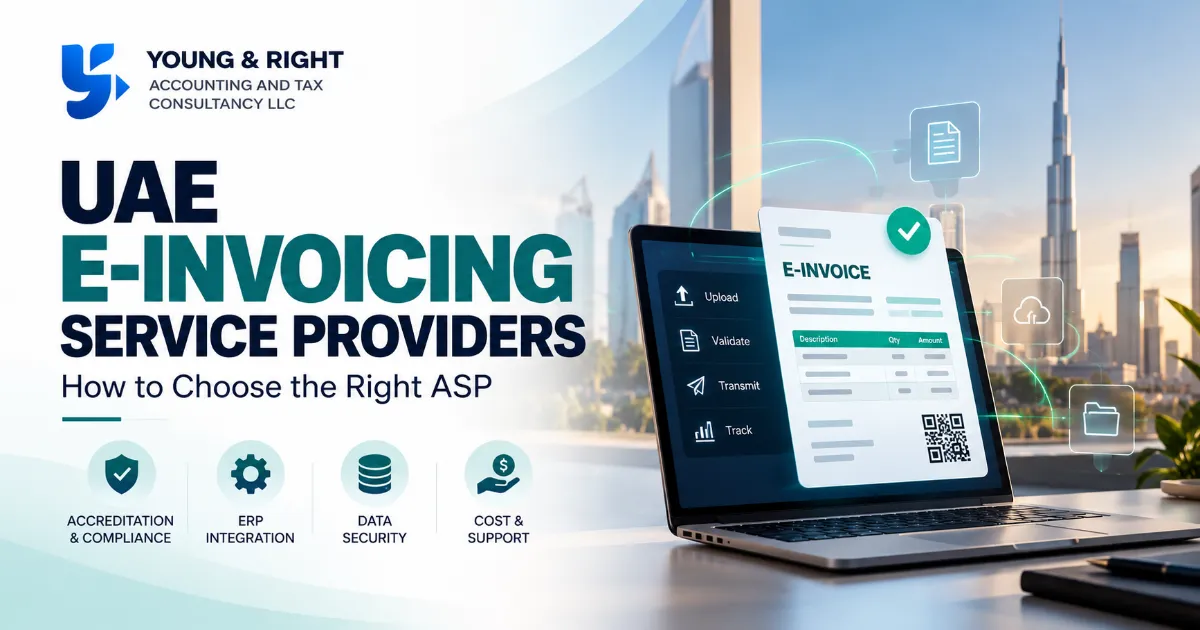
UAE E-Invoicing Service Providers: How to Choose the Right ASP in 2026
09/10/2026
From corporate tax registration to audits and bookkeeping, Young & Right offers personalized solutions that keep your business compliant and stress-free. Let’s take the complexity off your plate—starting with a free consultation.
Book Your Free Consultation
The UAE’s tax landscape is undergoing a digital revolution, with the electronic invoicing system at its heart. As businesses in the UAE prepare for the upcoming e-invoicing mandate, understanding the shift from manual records to a structured data format is critical for maintaining VAT compliance.
Starting 1 July 2026, the UAE will launch its pilot and adopting e-invoicing will initially be voluntary. However, the e-invoicing mandate will quickly become compulsory in phases. By July 2027, e-invoicing will become mandatory for nearly all VAT-registered businesses in the UAE.
The new e-invoicing model is built on the Universal Business Language (UBL) and the Peppol / PINT AE standard. This framework ensures that every invoice is exchanged in a machine-readable structured data format, specifically XML.
Federal Tax Authority (FTA): Under the Tax Procedures Law, the FTA oversees the central database. It receives tax data in near real-time to ensure tax transparency.
UAE Ministry of Finance (MoF): The MoF defines the uae’s e-invoicing requirements and provides the e-invoicing data dictionary, which lists all data fields required for a legal invoice.
Accredited Service Providers (ASP): An ASP acts as the mandatory link between your business and the FTA. UAE regulations specify that businesses must appoint an accredited provider to transmit electronic invoices.
For successful implementation of e-invoicing, businesses need to integrate certain components into their operational structure:
Role: ERPs are essential platforms where businesses generate e-invoices. They ensure the data required by the FTA—such as VAT amounts, TRNs (Tax Registration Numbers), and invoice numbers—are included in each e-invoice.
Compliance: ERPs need to be aligned with the FTA’s e-invoicing format and validation rules to ensure that businesses remain compliant. They act as the backbone of the e-invoicing process, ensuring invoices are created correctly and submitted to the FTA in the approved format.
The operational workflow involves several stages:
Supplier / Accounts Receivable (AR) Team: The AR team is responsible for creating and transmitting e-invoices. They must ensure that invoices contain all required data, such as VAT, TRN, and the invoice number.
Buyer / Accounts Payable (AP) Team: The AP team receives and processes e-invoices. Their role involves acknowledging receipt and integrating the data into their financial systems for payment processing.
E-invoicing follows a structured process:
Invoice Creation: The AR team generates the e-invoice using the ERP system.
Transmission: The e-invoice is transmitted to the FTA through an accredited service provider.
Validation: The FTA validates the invoice to ensure compliance with the required standards.
Acknowledgment: Once validated, the FTA sends an acknowledgment of receipt to both the supplier and the buyer.
Delivery: The e-invoice is delivered to the buyer, completing the cycle.
Understanding e-invoicing is just the first step; global best practices can help you stay compliant with uae laws while improving business transactions.
Adopt Early: Don't wait until 1 July 2026. Use the voluntary phase to prepare your business and test integrations.
Automate Validation: Use e-invoicing software that automatically checks against the e-invoicing rules to prevent rejections.
Secure Archiving: Under the UAE VAT law, data must be stored for at least 5 years (and up to 15 years for real estate). Ensure your e-billing system provides secure, searchable electronic storage.
Staff Training: Educate your team on the uae’s e-invoicing system to handle electronic invoicing system errors or system failure notifications, which must be reported to the FTA within two business days.
Using Non-Accredited Tools: Invoices must be processed through an ASP. Using uncertified software will lead to non-compliance.
Incomplete Data: Missing a mandatory field from the e-invoicing data dictionary will result in the tax administration rejecting the document.
Ignoring the Timeline: Failure to comply with e-invoicing requirements by your specific phase deadline (e.g., the 1 July 2026 pilot or the 2027 mandates) can result in heavy fines.
Mandatory e-invoicing compliance is being introduced in a phased rollout that primarily targets all VAT-registered entities engaged in Business-to-Business (B2B) and Business-to-Government (B2G) transactions within the UAE. Following the global shift toward digital transparency, the UAE has adopted a system that mandates the use of a specific invoice standard, specifically the Peppol PINT AE format in XML or JSON. Under the latest tax regulations (Ministerial Decisions No. 243 and 244 of 2025), compliance is determined by annual revenue thresholds: large taxpayers with revenue equal to or exceeding AED 50 million must implement the system by 1 January 2027, while all other in-scope businesses must comply by 1 July 2027. While Business-to-Consumer (B2C) transactions and certain sovereign or financial services are currently excluded, every business subject to the mandate is required to appoint an Accredited Service Provider (ASP) to facilitate real-time reporting to the Federal Tax Authority (FTA).
E-invoicing offers numerous benefits that go beyond compliance, including:
Improved Efficiency: By automating the invoicing process, businesses can save time and reduce the manual effort required for invoice creation, transmission, and validation.
Faster Payments: E-invoicing accelerates the payment process by eliminating delays caused by manual invoicing systems. Invoices are processed more quickly, leading to faster payments from customers.
Cost Savings: Digital invoices eliminate the need for paper invoices, reducing printing, mailing, and administrative costs.
Simplified VAT Filing: With all the data structured and validated, businesses can easily integrate e-invoices into their VAT filings, ensuring compliance and minimizing the risk of errors.
As the UAE government moves forward with mandatory e-invoicing regulations, businesses must adapt to the new framework to remain compliant. The UAE’s e-invoicing model is designed to enhance tax reporting, improve compliance, and streamline the overall tax system. With the deadline for implementing e-invoicing fast approaching, businesses must prepare for e-invoicing and ensure they meet all necessary e-invoicing standards and tax compliance requirements.
At Young & Right, we specialize in helping UAE businesses implement seamless and efficient e-invoicing solutions that align with the latest e-invoicing regulations. Our team of experts understands the complexities of the e-invoicing framework and is equipped to guide businesses through the process of adopting e-invoicing in the UAE. Here’s how we can support you:
With the UAE’s transition to mandatory e-invoicing, businesses must ensure that their invoicing processes comply with e-invoicing regulations and are prepared to submit tax invoices in a structured digital format. Young & Right provides clear, actionable advice on the e-invoicing standards set by the UAE government. We help businesses understand and implement the necessary e-invoicing platform that ensures the accurate creation, transmission, and storage of invoices in the required format. Whether you are transitioning from traditional PDF invoices or integrating new systems, we ensure your invoice data complies with the country’s evolving requirements.
As the UAE tax system continues to evolve, businesses must ensure they meet the stringent requirements for tax reporting and tax compliance. Young & Right offers expert consulting services to help businesses prepare for e-invoicing and ensure that their invoices in a structured digital format align with the UAE’s e-invoicing model. We will help you streamline your invoicing process, ensuring your tax invoices are created and submitted in full compliance with e-invoicing standards.
UAE is adopting a future-ready digital economy. Whether you are a small enterprise or a large corporation, you must ensure that your business is ready for the e-invoicing uae transition. By aligning with an ASP and upgrading your e-billing system, you can help your business comply and thrive.
For expert guidance on navigating the uae's e-invoicing landscape, Young & Right provides the consulting and tools necessary to ensure your business stays ahead of the curve.


Adopt best practices and streamline your invoicing process with expert support from Young & Right. Our tailored solutions ensure you meet all e-invoicing standards and regulatory requirements.
Schedule a Consultation Today