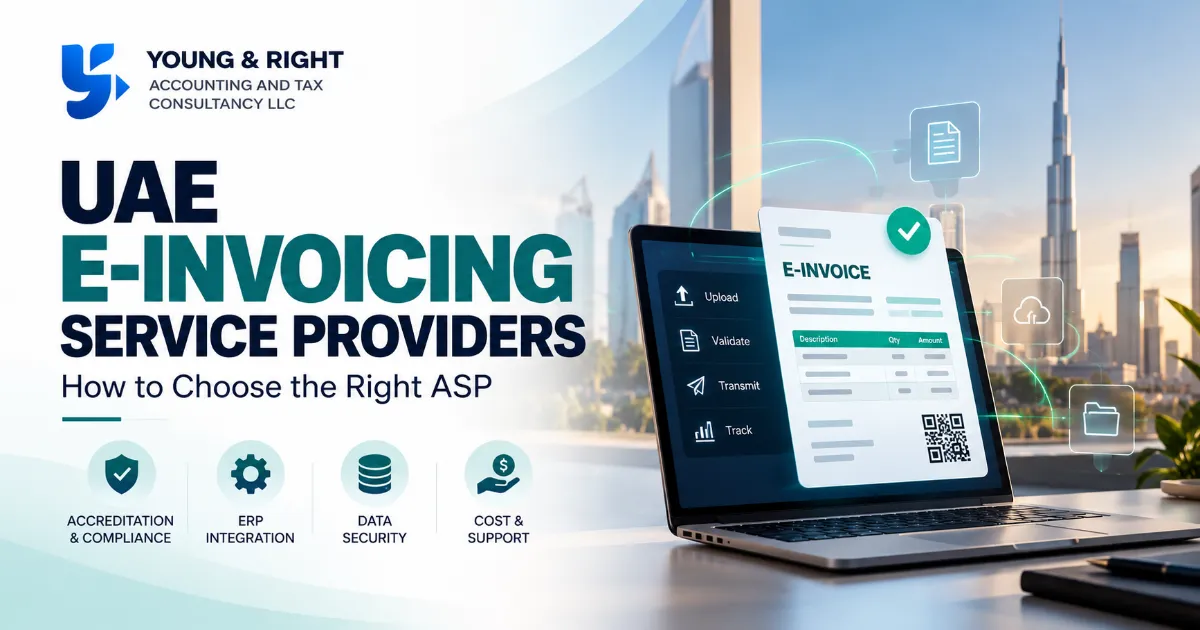
UAE E-Invoicing Service Providers: How to Choose the Right ASP in 2026
09/10/2026
From corporate tax registration to audits and bookkeeping, Young & Right offers personalized solutions that keep your business compliant and stress-free. Let’s take the complexity off your plate—starting with a free consultation.
Book Your Free Consultation

E-invoicing has emerged as a crucial tool for UAE businesses, especially in the context of the rapidly evolving digital tax landscape. By replacing traditional paper-based methods with a sophisticated electronic invoicing system, companies can improve efficiency, reduce errors, and ensure strict VAT compliance.
The UAE government, led by the Ministry of Finance and the Federal Tax Authority (FTA), has officially launched the UAE e-invoicing program. This initiative aims to streamline VAT reporting, reduce fraud, and ensure transparent financial transactions across the country.
E-invoicing is a structured digital format used for the creation, submission, and management of tax invoices. Unlike a simple PDF or scanned image, a true electronic invoice consists of invoice data in a machine-readable structured digital format (specifically XML).
The UAE's e-invoicing model is built on the Peppol framework, specifically using the Decentralized Continuous Transaction Control and Exchange (DCTCE)—often referred to as the 5-corner model. This ensures that every tax invoice is validated and reported in near real-time.
The e-invoicing process follows a clear path from the supplier to the government:
Invoice Creation: A UAE business generates tax data within their accounting or ERP system.
Accredited Service Provider (ASP) Validation: The data is sent to an accredited service provider. The ASP will validate invoices to ensure they meet the UAE standard (the PINT-AE data dictionary).
Real-Time Reporting: Once validated, the ASP transmits the tax data document directly to the Federal Tax Authority (FTA) and the recipient.
Integration: For seamless operations, most businesses use an ERP or accounting system that connects via API to their chosen e-invoicing solution.
Selecting the right partner is critical for successful implementation of e-invoicing and long-term tax compliance. Since uae implementing e-invoicing uses the Peppol 5-corner model, businesses cannot connect directly to the Federal Tax Authority (FTA). Instead, they must appoint an Accredited Service Provider (ASP). These providers act as the bridge, validating digital invoices and ensuring that tax reporting is handled in real-time. The overview of e-invoicing indicates that a high-quality provider will not only offer e-invoicing in the United Arab Emirates but will also provide seamless integration with your current ERP, such as SAP or Oracle, to minimize disruption to your daily operations.
Improved VAT Compliance: Automation ensures that every tax invoice meets UAE tax rules, eliminating the risk of incorrect filings and late penalties.
Enhanced Transparency: Every transaction is logged and stored within the UAE, allowing the FTA to use tax data for faster audits and fraud prevention.
Faster Payments: B2B and B2G transactions are processed faster because the invoicing system is standardized, reducing disputes and improving cash flow.
Cost Reduction: Moving to a digital format eliminates paper and storage costs while reducing manual data entry errors by up to 66%.
The UAE’s e-invoicing system operates through a centralized portal where businesses can manage their invoices and ensure compliance with VAT regulations. This portal streamlines the process, allowing for easy access and tracking of all invoices submitted to the FTA.
The system mandates the use of a standardized format for all invoices, ensuring consistency and making it easier for the FTA to process and verify VAT reports. This standardization includes required fields such as the VAT number, tax rate, and transaction details, making the invoicing process more streamlined and efficient.
To stay ahead of the rollout of e-invoicing, businesses should take the following steps:
Assess Readiness: Review your current invoicing system to see if it can export structured digital formats.
Select a Partner: Choose an accredited service provider from the Ministry of Finance pre-approved list.
Obtain a TIN: Ensure you have a Taxpayer Identification Number (TIN), as this is the primary identifier in the new system.
Cleanse Data: Ensure your customer TRN numbers and addresses are accurate for the UAE's e-invoicing model.
Technology Integration: Upgrading an ERP or accounting system to produce XML files instead of PDF versions can be a technical hurdle.
Knowledge Gaps: Staff must be trained to understand the new system and the e-invoicing framework.
Data Security: Because sensitive invoice data is transmitted digitally, businesses must ensure their e-invoicing services in UAE provide robust encryption.
As the UAE Ministry of Finance announced recently, the implementation of the e-invoicing system is a strategic shift for all UAE businesses to ensure higher compliance with UAE tax standards. Under the new e-invoicing mandate, all VAT-registered entities and even certain non-registered businesses must comply with e-invoicing for domestic B2B and B2G transactions. This e-invoicing compliance in the UAE is mandatory for B2B and B2G supplies, while B2C transactions remain out of scope for the initial phase. To prepare for e-invoicing UAE, businesses must align with the e-invoicing requirements set by the UAE VAT Law, which now officially recognizes digital invoices as the only valid tax documents. By adopting e-invoicing, companies can mitigate risks of tax evasion and leverage the potential of e-invoicing to automate financial reporting. The transition to e-invoicing will follow a phased rollout, starting with a voluntary pilot in July 2026 and moving toward mandatory e-invoicing by 2026 and 2027 for most taxpayers.
The shift to e-invoicing is being rolled out in stages to allow businesses time to prepare for mandatory requirements:
July 2026: The e-invoicing initiative officially begins with a pilot phase and voluntary adoption.
January 2027 (Phase 1): Mandatory e-invoicing begins for large taxpayers (typically those with annual revenue ≥ AED 50 million).
July 2027 (Phase 2): The compliance requirement extends to other taxpayers.
Ongoing Scope: The mandate currently focuses on B2B and B2G transactions (Business-to-Business and Business-to-Government).
At Young & Right, we help businesses navigate the adoption of e-invoicing in the UAE, ensuring smooth implementation and full compliance with UAE tax regulations. As the UAE transitions to mandatory e-invoicing, we guide you through the process, from integrating the system to ensuring accurate VAT reporting.
We offer:
Expert consultation on e-invoicing requirements in the UAE.
Support with implementation and integration into your existing systems.
Ongoing compliance monitoring to keep you updated with regulatory changes.
Partner with Young & Right to streamline your invoicing processes and stay compliant with the latest UAE e-invoicing laws.
As we move toward July 2026, implementing e-invoicing is no longer optional—it is a cornerstone of operating in the UAE. UAE businesses that embrace this e-invoicing program early will gain a competitive edge through better data accuracy and mandatory compliance.
At Young & Right, we help you navigate the UAE’s e-invoicing framework and ensure your business is ready for the 2026 mandate.


Let Young & Right guide you through the seamless adoption of e-invoicing in the UAE. We’ll ensure you comply with UAE tax regulations and take full advantage of the benefits it offers, from enhanced tax compliance to improved cash flow management.
Get Started with E-Invoicing