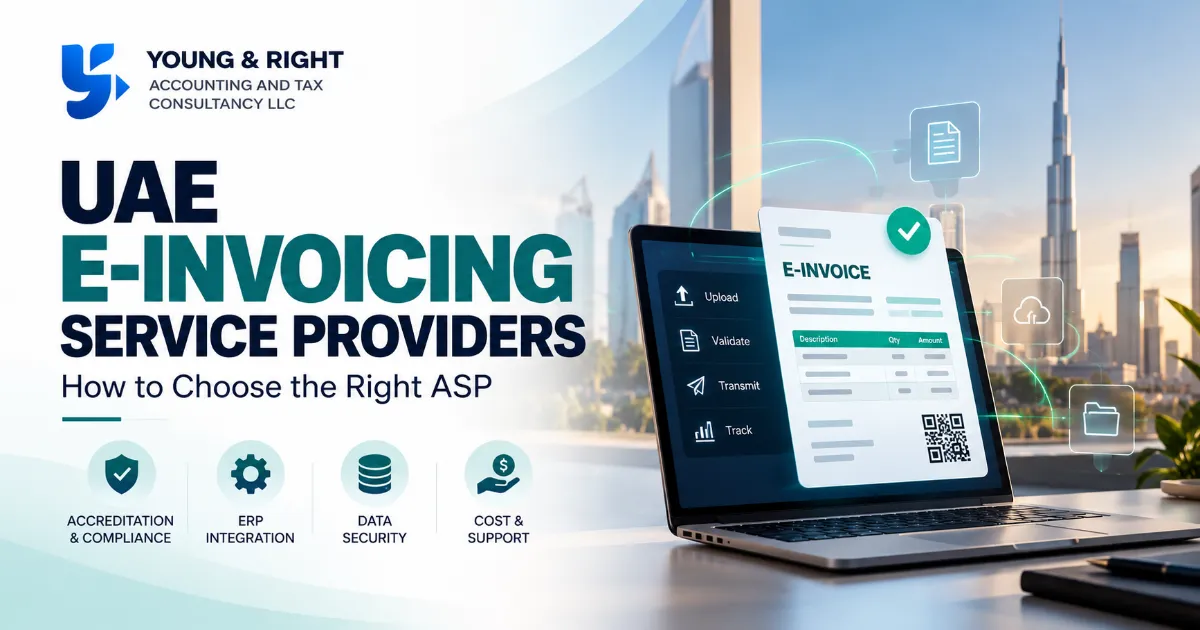
UAE E-Invoicing Service Providers: How to Choose the Right ASP in 2026
09/10/2026
From corporate tax registration to audits and bookkeeping, Young & Right offers personalized solutions that keep your business compliant and stress-free. Let’s take the complexity off your plate—starting with a free consultation.
Book Your Free Consultation

As the United Arab Emirates moves toward a fully digitized economy, the UAE e-invoicing system has emerged as a critical priority for all UAE businesses. The introduction of a uae e-invoicing mandate is not simply a technological upgrade; it is a legal requirement designed to modernize the VAT compliance framework, reduce fraud, and boost real-time tax administration.
Under Cabinet Decisions 243 and 244 of 2025, the e-invoicing mandate marks a major shift. From a pilot in July 2026, the phased rollout will eventually make compliance mandatory for most businesses. This guide provides a comprehensive breakdown of the e-invoicing implementation timeline and the key requirements you must meet to stay compliant.
E-invoicing in the UAE refers to the generation, transmission, and storage of electronic invoices and credit notes in a required XML format (specifically UBL 2.1). Unlike a simple PDF, a compliant e-invoice in the UAE is a tax data document that allows for end-to-end e-invoicing and automatic processing by the UAE government.
To ensure interoperability, the UAE has adopted the Peppol framework. This means the UAE has adopted an international standard for Peppol e-invoicing, ensuring that invoice and tax data can be exchanged securely between different accounting systems.
The e-invoicing implementation timeline is structured to allow businesses to adapt. Phased implementation requirements suggest that the first group—typically large taxpayers with annual taxable supplies exceeding AED 50 million—will lead the way.
July 2026: Development and pilot in July 2026 for selected businesses.
31 July 2026: Expected completion of initial registration for the first phase.
July 2027: The July 2026 and mandatory 2027 window represents the transition for Phase 1 entities to go live with the UAE’s e-invoicing mandate.
Under the latest e-invoicing regulations issued by the Ministry of Finance, the United Arab Emirates is transitioning to a decentralized 5-corner model for tax reporting. Navigating e-invoicing in UAE requires businesses to adopt mandatory e-invoicing for all B2B and B2G transactions, starting with a pilot phase in July 2026. To maintain e-invoicing compliance, all compliant e-invoices in the UAE must be generated in a structured XML format and reported in real time (or near real-time) to the Federal Tax Authority (FTA). A critical mandate of the e-invoicing requirements is that all tax data and electronic records must be stored within the UAE; foreign or offshore hosting is strictly prohibited. Businesses must remain vigilant of the e-invoicing deadlines, as non-compliance with the UAE legal framework—including failure to appoint an Accredited Service Provider (ASP) or ensure local storage within the UAE—can result in monthly penalties of up to AED 5,000.
The scope of e-invoicing primarily targets B2B and B2G transactions. While B2B and B2G invoices are the focus, certain B2B and B2G transactions may have specific exemptions under the current UAE e-invoicing rules.
UAE businesses must generate invoices in the required structured format. Every tax invoice must contain specific invoice data fields, including:
Seller and Buyer TRNs (Tax Registration Numbers).
Detailed invoice and credit note data.
Standardized data fields required by the MoF.
Under the new law, businesses must ensure they appoint an accredited service provider. You must appoint an accredited service provider (ASP) to act as your Peppol Access Point. The role of accredited service providers is to validate your e-invoicing data and ensure it is successfully reported to the FTA (Federal Tax Authority).
The e-invoicing process requires that invoice and tax data be reported to the FTA in real-time or near-real-time. This ensures that the invoice to the tax authority is transmitted at the same time it is issued to the buyer.
A critical aspect of UAE e-invoices is that the data must be stored within the country. All e-invoicing data and electronic invoices and credit notes must be stored within the geographical boundaries of the UAE to comply with national security and UAE VAT law.
The UAE e-invoicing framework is governed by the following key authorities:
Owns and supervises the national e-invoicing programme.
Issues legal and technical standards, including data fields and invoice structures.
Maintains a list of Accredited Service Providers (ASPs) authorized to facilitate compliant invoicing.
Oversees implementation, reporting, and compliance enforcement.
Requires real-time or near-real-time invoice data reporting.
May conduct audits and impose penalties for violations.
All VAT-registered businesses conducting B2B or B2G transactions.
Government entities, starting from a later phase.
Entities involved in real estate, finance, logistics, and retail sectors.
Any company may voluntarily adopt e-invoicing before the mandatory deadline, starting from 1 July 2026.
B2C transactions (currently excluded).
Certain sovereign government transactions.
Specific international transport services, and VAT-exempt financial services.
Invoices must:
Be created using a structured electronic format (e.g., XML or UBL).
Include all MoF-specified fields (buyer/seller details, VAT breakdowns, TRNs, etc.).
Be issued and transmitted via an Accredited Service Provider (ASP).
Non-VAT registrants: e-invoices must be issued within 14 days of the business transaction.
VAT registrants: as per VAT time of supply rules.
All invoices must be transmitted via an ASP, which ensures routing, validation, and secure delivery.
ASPs must meet strict technical, financial, and cybersecurity requirements (e.g., Peppol certification, ISO 27001).
Real-time or near-real-time reporting is mandatory.
ASPs typically handle this reporting, but you remain responsible for compliance.
Must store all invoices in electronic format within the UAE.
Must ensure accessibility, integrity, and readability for audit purposes.
Retention:
Standard: 5 years.
Real estate: 15 years.
Disputes/investigations: extendable by 4 years.
Failure to comply with the UAE e-invoicing framework can result in significant penalties under Cabinet Decision No. 106 of 2025:
Failure to appoint ASP: AED 5,000/month (per period of delay).
Failure to issue/transmit eInvoices: AED 100 per document (capped at AED 5,000/month).
Failure to report system failures: AED 1,000/day.
Failure to notify data changes: AED 1,000/day.
While making e-invoicing mandatory is a regulatory shift, the benefits of e-invoicing extend to business efficiency:
Reduced Errors: Automation eliminates manual entry in the e-invoicing infrastructure.
Faster Payments: B2B and B2G invoices are processed faster.
VAT Accuracy: Simplifies UAE VAT filing and reconciliations.
Transparency: E-invoicing represents a move toward a more transparent, fraud-free market.
Meeting the UAE’s mandatory e‑invoicing obligations requires more than adopting new software—it demands a clear compliance strategy aligned with e‑invoicing regulations, operational readiness, and ongoing tax compliance. This is where Young & Right becomes a trusted partner for businesses navigating e‑invoicing in the UAE.
Our team supports organisations at every stage of the electronic invoicing system lifecycle, ensuring you issue compliant e‑invoices in the UAE, meet real‑time reporting expectations, and avoid the risks of non‑compliance with the UAE framework.
Young & Right helps you understand and implement e‑invoicing requirements based on your business size, industry, and revenue thresholds, including whether you fall under the AED 50 million mandatory phase. We translate regulatory obligations into practical compliance steps that your finance and IT teams can follow with confidence.
We begin with a detailed assessment of your current invoicing and tax processes to identify gaps against UAE e‑invoicing compliance rules. This includes reviewing:
Invoice and credit notes through the electronic invoicing workflow
Readiness for issuing notes through the electronic invoicing system
Alignment with e‑invoicing deadlines under the phased rollout
The UAE’s e-invoicing mandate is a transformative step for the United Arab Emirates. E-invoicing covers every aspect of the modern transaction cycle, from the moment you generate invoices in the required format to the long-term retention requirements.
To ensure compliance, businesses must act now. Start by auditing your current e-invoicing infrastructure, understanding the phased implementation, and selecting the right partner to manage your invoice and credit note data.


Stay ahead of the 2026–2027 e‑invoicing regulations with expert guidance from Young & Right. From MoF-aligned setup to real-time reporting, we simplify compliance for businesses of every size.
Get E‑Invoicing Support Now