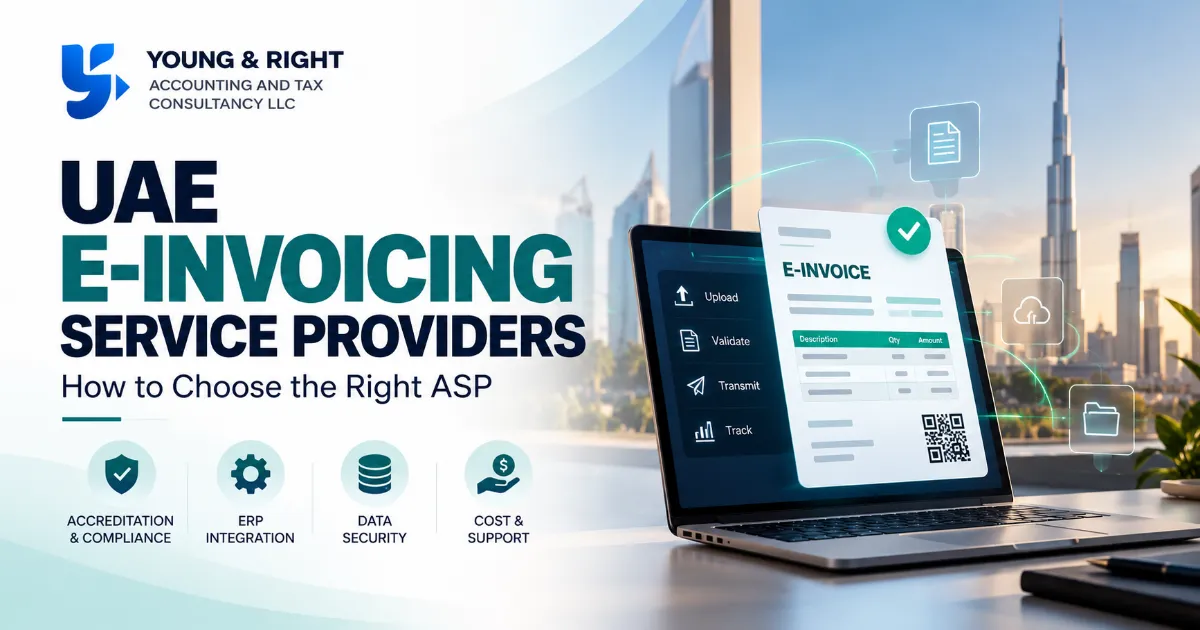
UAE E-Invoicing Service Providers: How to Choose the Right ASP in 2026
09/10/2026
From corporate tax registration to audits and bookkeeping, Young & Right offers personalized solutions that keep your business compliant and stress-free. Let’s take the complexity off your plate—starting with a free consultation.
Book Your Free Consultation

In 2023, the United Arab Emirates introduced corporate tax laws that apply to businesses operating within its borders. This marks a major shift for a country that was previously known for its tax-free status. The introduction of corporate tax was implemented to align with international standards and to diversify the country’s revenue streams.
This detailed guide will walk you through the corporate tax calculation process, from determining your taxable income to understanding the allowable deductions and exemptions. Whether you’re a small business owner, a corporate executive, or a finance professional, understanding how to calculate corporate tax returns in the UAE is essential for compliance and business success.
Corporate tax is a tax levied on the profits of businesses. For many years, the UAE was considered a tax haven due to the absence of a broad-based corporate tax. However, with the introduction of the 9% corporate tax on income exceeding a specific threshold, the country has aligned itself with global tax norms.
The corporate tax rate is applied to the company’s taxable income, which is the income remaining after all allowable deductions and exemptions. The move towards corporate tax not only helps boost the UAE's economy but also promotes transparency and encourages businesses to operate ethically.
To accurately calculate corporate tax returns, there are several key elements businesses must understand. Below, we explain the main components involved in calculating corporate tax in the UAE.
The corporate tax rate in the UAE is set at 9% on taxable income that exceeds a specific threshold. This means that any business earning more than the threshold amount is liable to pay 9% of its taxable income in corporate tax.
It’s important to note that businesses with earnings below this threshold may not be subject to the full 9% tax rate, or they may be exempt, depending on the nature of their business and income.
Taxable income is the amount of profit a business earns after applying allowable deductions and exclusions. This is the amount that is subject to the corporate tax rate.
Taxable income is derived from the company’s net profit as reflected in the financial statements (income statement). The calculation involves subtracting allowable business expenses from the business's total income.
Certain types of income are exempt from tax under UAE law. These include:
Income from free zone businesses: Businesses located in designated free zones that meet specific regulatory criteria are eligible for tax exemptions.
Income from foreign branches: In some cases, income generated by foreign branches of UAE-based companies may be exempt from UAE tax.
Dividend income: Income derived from dividends paid by other UAE-based companies may also be excluded from taxable income.
Understanding what qualifies as exempt income is crucial in accurately calculating taxable income and reducing the overall tax liability.
The UAE corporate tax regime allows businesses to apply deductions to reduce their taxable income. These deductions help lower the amount of tax a business owes. Some common allowable deductions include:
Employee salaries and benefits: Costs associated with staff wages and employee benefits can be deducted.
Rent for business premises: Rent expenses for office space or commercial property used for business operations are deductible.
Operational expenses: This includes expenses for utilities, office supplies, business-related travel, and advertising.
Depreciation: The depreciation of business assets, such as equipment, machinery, and vehicles, can also be deducted.
By applying these deductions, businesses can reduce their taxable income and, consequently, their tax liability.
Free zones in the UAE offer significant tax advantages. Many businesses operating within these zones benefit from a 0% corporate tax rate, provided they meet the conditions set by the UAE government. These conditions typically include:
Operating exclusively within the free zone and adhering to specific business activity regulations.
Meeting specific employment and revenue generation criteria.
The process for calculating corporate tax returns in the UAE involves several steps. Here’s a simple breakdown to help you understand the flow of the calculation process.
The first step in calculating corporate tax is to determine your company’s net profit. This figure can be found in your company’s income statement and reflects the overall revenue after accounting for direct expenses such as the cost of goods sold (COGS), operational expenses, and other business-related costs.
After determining your net profit, you need to apply deductions. These deductions may include:
Salaries, rent, and utilities: Deducting these operational costs reduces your taxable income.
Depreciation of assets: This is also considered an allowable deduction, especially for businesses with significant physical assets.
Once deductions are applied, you’ll arrive at the adjusted profit.
After applying allowable deductions, it’s time to exclude exempt income. For example, income earned from free-zone operations or foreign income that qualifies for exemptions under the UAE tax laws should be excluded from your taxable income.
By excluding exempt income, your taxable income will be further reduced.
Once you have calculated your taxable income by subtracting deductions and exempt income, you’ll apply the 9% corporate tax rate. This is the standard rate for businesses that exceed the threshold.
Formula:
Corporate Tax = Taxable Income × 9%
This will give you the amount of corporate tax your business needs to pay.
If your business is based in a free zone, you may be eligible for the 0% corporate tax rate on certain income. However, your business must meet the required conditions, such as operating exclusively within the free zone and not engaging in activities outside of the specified business activities allowed in the free zone.
At Young & Right, we specialize in corporate tax advisory and compliance services for businesses operating in the UAE. Our experienced team of tax consultants and accountants are here to help you understand your tax obligations, maximize tax savings through deductions and exemptions, and ensure that your business remains compliant with UAE tax laws.
We provide tailored solutions for businesses of all sizes, from start-ups to large enterprises, and assist with everything from tax calculations to filing tax returns.
Understanding how to calculate corporate tax returns in the UAE is critical for all businesses operating within the country. By following the steps outlined in this guide, businesses can ensure they are compliant with tax regulations and reduce their tax liabilities through deductions and exemptions.
For expert guidance on corporate tax filings and to take advantage of the available tax exemptions, contact Young & Right today. Our team will ensure that your business stays compliant and makes the most of the tax benefits available in the UAE.