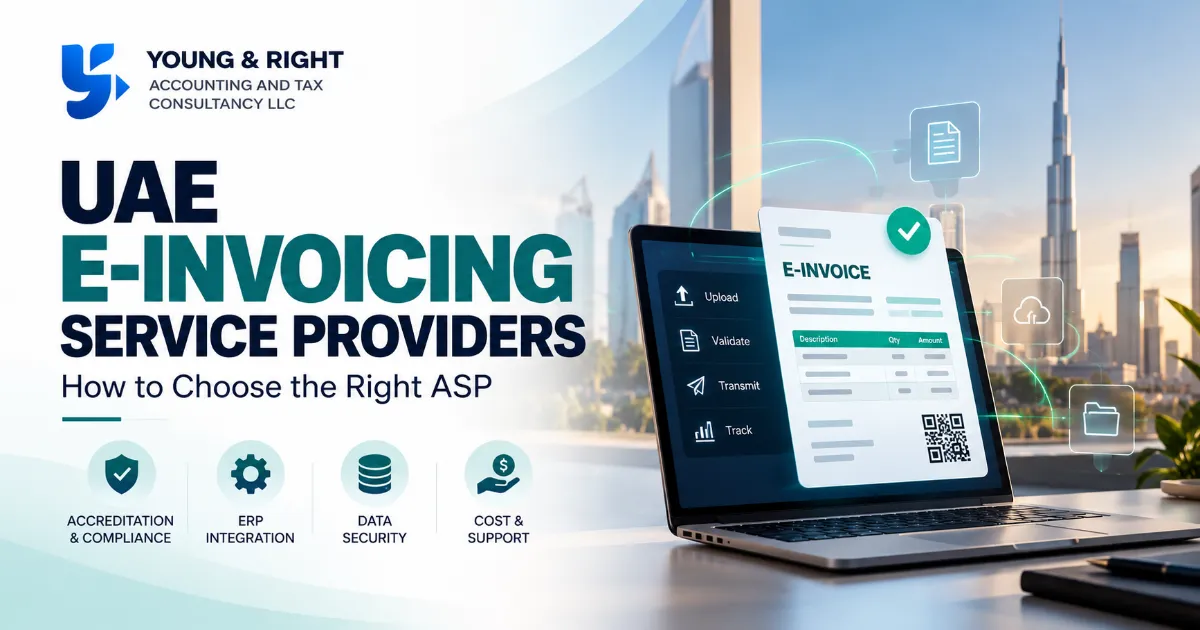
UAE E-Invoicing Service Providers: How to Choose the Right ASP in 2026
09/10/2026
From corporate tax registration to audits and bookkeeping, Young & Right offers personalized solutions that keep your business compliant and stress-free. Let’s take the complexity off your plate—starting with a free consultation.
Book Your Free Consultation
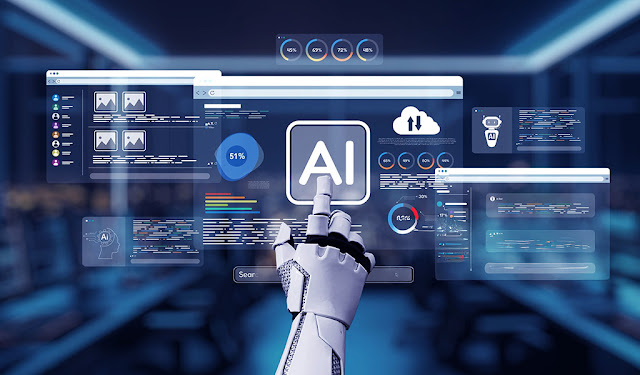
Artificial intelligence in accounting is no longer a distant concept; it is a game-changer in modern finance that is currently transforming accounting as we know it. By leveraging AI technologies, accounting and finance teams are streamlining operations, increasing accuracy, and gaining access to real-time insights.
As accounting firms are using AI to incorporate AI into their daily operations, the impact of AI is clear: it allows accountants and finance professionals to move away from routine accounting tasks and focus on high-value advisory roles. This guide explores how AI is reshaping the accounting landscape in 2025 and the best AI tools for accounting you should adopt today.
The Rise of AI in Accounting Automation
The adoption of AI in accounting has evolved beyond simple scripts. Today, AI-powered tools leverage machine learning and generative AI to optimize decision-making and predictive analytics. Whether it is robotic process automation (RPA) for data entry or AI to analyze complex contracts, these AI solutions are built to handle the rigors of a modern accounting system.
Key Drivers of AI Adoption in Accounting Automation
Efficiency & Process Automation: AI excels at automating repetitive accounting tasks, which reduces manual labor and saves time.
Enhanced Accuracy: AI can help process vast amounts of data with precision, ensuring that complex accounting remains error-free.
AI in Financial Forecasting: By using AI to analyze historical data, firms can predict trends, helping accounting and finance professionals make data-driven decisions.
Compliance & Risk Management: AI helps businesses stay compliant with shifting tax laws and auditing standards by monitoring changes in real-time.
Top AI Tools in Accounting Automation
1) Datarails
Category: Research and Data
Description: Datarails is a leading AI-powered platform that streamlines financial reporting and offers advanced insights for finance teams. It consolidates data in real-time, providing actionable insights through automated reporting.
Key Features:
Real‑time Data Consolidation: Seamlessly consolidates data from different sources in real time.
Excel‑First Interface: Works natively within Excel, allowing easy integration with existing workflows.
Scenario Modeling & Forecasting: Helps finance teams model different financial scenarios and forecast future performance.
Custom Dashboards & Reporting: Provides custom dashboards for a clearer view of key financial metrics.
Multi‑Entity Support: Efficiently handles complex, multi-entity structures.
2) AlphaSense
Category: Research and Data
Description: AlphaSense is an AI-powered market intelligence platform for finance professionals, specializing in searching financial documents and deriving actionable insights.
Key Features:
Deep Search of Financial & Regulatory Documents: Quickly searches through vast datasets of regulatory and financial reports.
Natural Language Intelligence: Uses NLP to extract key information from complex documents.
Trend Alerts & Watchlists: Notifies users of significant financial trends and regulatory changes.
Document Analytics & Summarization: Automatically summarizes documents and reports for quick analysis.
3) Ascent
Category: Regulatory and Compliance
Description: Ascent leverages AI to help financial services automate compliance processes, ensuring businesses remain up-to-date with regulatory changes.
Key Features:
Rule‑Mapping: Helps finance teams map and automate compliance rules.
Text Intelligence: Analyzes large volumes of regulatory text to identify key compliance requirements.
Change Monitoring: Monitors regulatory changes in real time and notifies teams of necessary actions.
4) MindBridge
Category: Auditing
Description: MindBridge AI analyzes entire transaction datasets to detect anomalies, risks, and patterns that could indicate fraud or errors in financial reports.
Key Features:
100% Transaction Coverage: Analyzes all transactions, ensuring no data is missed.
Anomaly & Risk Scoring: Flags any unusual transactions for deeper analysis.
Visual Dashboards: Provides an easy-to-read visual interface for financial data analysis.
5) Trullion
Category: Auditing & Compliance Workflows
Description: Trullion helps automate lease accounting, revenue recognition, and audit workflows with AI assistance. It ensures compliance with accounting standards such as ASC 842 and IFRS 16.
Key Features:
Contract Extraction: AI extracts key data from contracts to ensure accurate accounting.
Lease & Revenue Automation: Automates revenue recognition and lease accounting processes.
Journal Entry Generation: Automatically generates journal entries from extracted contract data.
How AI is Reshaping the Accounting Profession
A common question is: Will AI replace accountants? The consensus among experts is that while AI can automate the "grunt work," it cannot replace the professional judgment of accounting professionals. Instead, AI transforms the role of the accountant from a data processor to a strategic consultant.
Key Areas Where AI Adds Value:
Accounting Practice Management: AI software can manage client onboarding and project tracking.
Audit Readiness: AI works 24/7 to ensure every accounting workflow is documented and compliant.
Real-time Analysis: AI helps accounting firms provide instant feedback to clients rather than waiting for month-end reports.
Benefits of AI in Accounting Automation
Increased Productivity: By automating repetitive tasks, accounting teams can focus on more strategic activities.
Enhanced Decision Making: AI tools provide insights that improve forecasting, budgeting, and resource allocation.
Error Reduction: Automated processes are less prone to human error, ensuring accuracy in financial records.
Regulatory Compliance: With built-in compliance features, AI tools help businesses adhere to constantly changing regulations.
Cost-Effectiveness: Over time, AI-driven automation significantly reduces labor costs and the need for manual oversight.
Best AI Accounting Software
Choosing the right AI software in 2025 means looking for a platform that balances deep automation with intuitive user control. AI is no longer just an experimental add-on; it is the core engine behind leading tools like QuickBooks Online and Xero, which now use autonomous agents to manage everything from predictive cash flow to complex bank reconciliations. For firms with high-volume needs, Vic.ai provides specialized accounts payable automation, while Botkeeper offers a unique hybrid approach by combining machine learning with professional human oversight. By integrating AI at your accounting firm, you can move beyond manual entries and rely on AI in your accounting processes to ensure 100% audit coverage and real-time financial accuracy.
Common Use Cases for AI Accounting Software
Modern AI in your accounting processes provides a competitive edge by transforming how data is handled across the entire financial lifecycle. AI is no longer a luxury reserved for tech giants; it is now a practical necessity for automating high-volume tasks like invoice processing, where OCR technology extracts data and matches it to purchase orders instantly. Other frequent applications include real-time anomaly detection to prevent fraud, automated bank reconciliations, and predictive cash flow forecasting that adapts as market conditions shift. By choosing the right AI that aligns with your specific operational needs, you can shift your team's focus from manual entry to high-impact advisory roles. Implementing tools like QuickBooks, Xero, or Vic.ai allows for seamless AI at your accounting firm, ensuring faster month-end closes and significantly higher data accuracy.
How Is AI Used in Accounting Firms
Modern accounting firms are using AI to shift from manual data entry to high-level strategic advisory. By integrating tools like automated ledger systems, firms can handle vast datasets with speed that far exceeds human capacity. Implementing AI in your accounting processes allows for 24/7 monitoring of transactions to detect fraud and ensure 100% audit coverage. Because AI is no longer a complex luxury, choosing the right AI helps small and large firms alike automate tax categorization and complex reconciliations. Ultimately, deploying AI at your accounting firm frees your team to focus on interpreting data rather than just recording it.
The Future of AI in Accounting Automation
AI in accounting is expected to become even more intuitive by the end of 2025. We anticipate:
Smarter AI Systems: Algorithms that learn and adapt to unique accounting practice patterns.
Seamless Integration: AI will help bridge the gap between cloud-based ERPs and standalone AI accounting apps.
New Accounting Jobs: The future of accounting will see a rise in "Financial Data Scientists"—professionals who manage the AI tools that run the firm.
How Young & Right Can Help You with AI Tools in Accounting Automation
At Young & Right, we understand the evolving role of AI in accounting and how essential it is to integrate AI-powered accounting solutions into your finance and accounting workflows. As AI becomes a central part of modern accounting software, we offer expert guidance and services to help you choose and implement the right AI tools that best suit your business needs. Our expertise in AI algorithms and accounting solutions ensures that you leverage the full potential of AI tools to streamline your operations and gain deeper insights.
Why Choose Young & Right for AI in Accounting Automation?
As businesses grow, so do their accounting requirements. Traditional methods are often no longer sufficient to keep up with the complexity of modern financial management. That's where AI accounting tools come in. Here's how we can assist you in integrating AI into your accounting processes:
Selecting the Right AI Tools: With so many tools on the market, it can be challenging to choose the top AI accounting tools that fit your needs. At Young & Right, we help you learn how AI can analyze vast datasets, identify patterns, and automate repetitive tasks to improve accuracy and efficiency in your accounting firm.
Comprehensive Suite of AI Solutions: We offer a comprehensive suite of tools for businesses of all sizes, designed to enhance every aspect of your accounting operations—from accounting software to advanced AI algorithms. Whether it's accounting solutions for small businesses or enterprise-level management tools, we ensure you have access to the best AI-powered accounting technology.
Use Case Implementation: Our team helps you design a tailored use case for integrating AI into your specific accounting processes, ensuring that you maximize the AI benefits. From AI accounting software to AI automates key tasks, we guide you through the transition, offering hands-on support and training to ensure a smooth integration.
AI’s Role in Accounting: AI in your accounting isn’t just about automating routine tasks; it’s about enhancing decision-making. We help you understand AI’s role in accounting, such as how AI can assist with tax calculations, financial reporting, fraud detection, and much more.
Learning How AI Works: We provide resources and support to learn how AI integrates into your accounting firm. Our guide to AI in accounting covers everything from the basics of AI accounting software to the latest advancements in AI accounting tools.
AI Benefits for Your Firm: With our expertise, we can show you how AI can analyze financial data quickly and accurately, reducing errors and improving reporting timelines. The implementation of AI algorithms helps uncover trends and makes forecasting more reliable.
Conclusion
The use of AI is the defining trend of this decade for the accounting profession. By choosing to adopt AI, your accounting firm can drive productivity and ensure you remain competitive. AI is transforming accounting into a faster, more accurate, and more strategic field.


Adopt the right AI accounting tools to automate workflows, improve accuracy, and elevate your firm from compliance to strategic advisory.
Get in touch