
Corporate Tax Return Filing in the UAE: Documents, Deadlines and Process
09/10/2026
From corporate tax registration to audits and bookkeeping, Young & Right offers personalized solutions that keep your business compliant and stress-free. Let’s take the complexity off your plate—starting with a free consultation.
Book Your Free Consultation
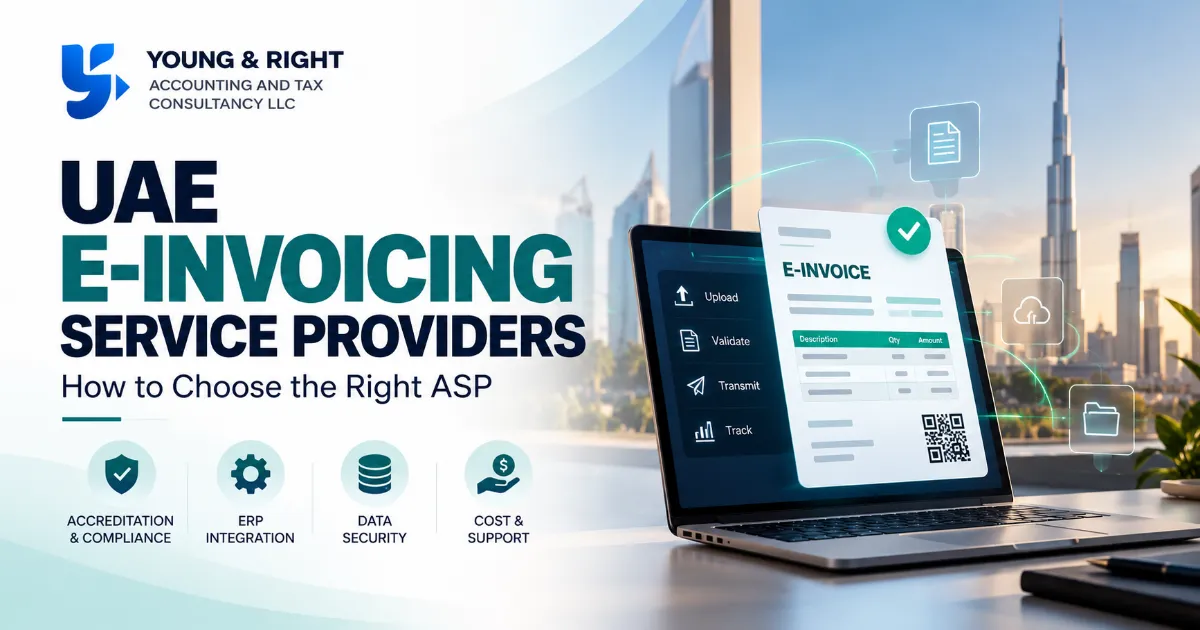
Your accounting software may be ready to create invoices. But is your business ready to exchange them under the UAE's new e-invoicing system?
For thousands of UAE businesses, choosing the right technology partner is becoming an important compliance decision. With mandatory electronic invoicing approaching, selecting an Accredited Service Provider (ASP) is not simply about buying another software subscription.
It is about protecting business continuity, maintaining accurate tax records and preparing for a more connected digital economy.
Quick Answer: To choose the right UAE e-invoicing service provider, verify Ministry of Finance accreditation, confirm compatibility with your accounting software, review data security, compare total costs, test invoice processing and evaluate technical support.
Let's explore what every UAE business should know.
An Accredited Service Provider (ASP) is a provider authorised by the UAE Ministry of Finance to deliver electronic invoicing services under the country's regulatory framework.
Unlike traditional PDF invoices, UAE e-invoices contain structured electronic data that can be processed, exchanged and reported digitally.
The UAE's framework is based on the Peppol network and uses a decentralised electronic invoice exchange model.
An ASP performs important functions, including:
Receiving invoice information from business systems.
Validating and converting invoice data into the required format.
Transmitting electronic invoices through approved channels.
Supporting the reporting of required tax data.
Communicating processing and delivery statuses.
Important distinction: Having accounting software does not automatically mean your business has appointed an accredited e-invoicing provider.
The UAE Ministry of Finance introduced significant developments in its electronic invoicing programme during 2026.
On 9 October 2026, the Ministry announced Ministerial Decision No. 168 of 2026, establishing an updated accreditation framework for e-invoicing service providers.
The framework replaces the earlier pre-approval approach with updated accreditation requirements intended to demonstrate technical capability, operational readiness and compliance.
This makes it particularly important to verify a provider's current accreditation status before signing an agreement.
| Business category | ASP appointment deadline | Mandatory implementation |
|---|---|---|
| Businesses with annual revenue of AED 50 million or more | 30 October 2026 extension applies to qualifying businesses above AED 50 million | 1 January 2027 |
| Businesses with annual revenue below AED 50 million | 31 March 2027 | 1 July 2027 |
| In-scope government entities | 31 March 2027 | 1 October 2027 |
The October 2026 appointment extension was introduced for the specified higher-revenue category. Businesses at the AED 50 million boundary should verify the applicable amended decision rather than assume that the extension automatically applies.
These dates reflect the published framework as of October 2026 and should be rechecked before taking action.
The first question should always be: Is this provider currently accredited?
The Ministry of Finance publishes a list of accredited e-invoicing service providers.
Before making a commitment, verify the provider's legal name, accreditation details and current status against the official directory.
Do not confuse a software reseller, implementation consultant or previously pre-approved company with a currently accredited provider.
An attractive website or low subscription fee does not replace regulatory verification.
Your ASP should work effectively with the systems your business already uses.
Whether your company uses Zoho Books, QuickBooks, Odoo, SAP, Oracle or another ERP platform, ask how invoice data will move between your existing software and the ASP.
Important questions include:
Is there a ready-made integration?
Will manual data entry be required?
How are credit notes and invoice corrections handled?
Can the solution support multiple branches or legal entities?
For example, a Dubai trading company issuing hundreds of invoices monthly may benefit significantly from automated data exchange rather than manually uploading individual documents.
Electronic invoices contain sensitive customer information, transaction values and commercial details.
Your chosen provider should demonstrate appropriate information security and business continuity arrangements.
Ask about encryption, access controls, backup procedures, incident management and relevant certifications.
Also review contractual provisions covering data ownership, retention, confidentiality and service termination.
A reliable ASP should help protect your financial information, not simply transmit it.
The cheapest quotation is not necessarily the most economical solution.
Some providers may charge separately for onboarding, software integration, document processing, additional users, technical support or custom development.
Compare the total expected cost over at least the first year.
Request a written quotation covering implementation, recurring subscription fees, transaction-based charges and any additional service costs.
This approach can help prevent unexpected expenses after integration begins.
A demonstration is useful, but real transaction testing provides stronger evidence of operational readiness.
Ask the provider to test representative invoices from your business, including different VAT treatments, customer types and credit notes.
Confirm what happens when invoice data contains errors.
Can your team identify a rejected invoice, correct the information and resubmit it efficiently?
Clear error-handling procedures are essential for preventing invoicing disruptions.
Imagine your company cannot transmit invoices on a busy month-end.
Who will resolve the issue?
Before appointing an ASP, review support availability, escalation procedures, incident response commitments and service-level agreements.
Businesses processing large invoice volumes should pay particular attention to system uptime, support capacity and recovery arrangements.
Your current business requirements may be relatively simple. However, your organisation could expand into additional branches, business activities or international markets.
Choose a solution that can accommodate reasonable future growth.
Review whether the ASP supports increasing transaction volumes, multiple entities, additional integrations and evolving regulatory specifications.
The right ASP should fit both your current operations and your planned growth.
Before selecting an ASP, evaluate each shortlisted provider against the following criteria:
| Evaluation criterion | What to confirm |
|---|---|
| Accreditation | Current MoF accreditation |
| Integration | Compatibility with existing accounting systems |
| Compliance | Support for UAE invoice specifications |
| Security | Data protection and access controls |
| Pricing | Transparent total implementation and recurring costs |
| Support | Defined response times and escalation procedures |
| Scalability | Support for future growth |
Avoid signing a long-term agreement before reviewing these areas.
One of the biggest mistakes is choosing a provider solely because it offers the lowest price.
Another is assuming existing PDF invoicing processes will satisfy the new requirements without technical changes.
Businesses should also avoid waiting until the last moment to assess their invoice data, customer information and accounting software.
Poor master data, inconsistent VAT treatment and missing customer details can complicate implementation.
A practical starting point is to review your existing invoicing workflow before comparing providers.
Choosing an accredited technology provider is only one part of UAE e-invoicing readiness.
Your underlying accounting records, VAT treatment, customer information and invoicing procedures must also be properly organised.
At Young & Right Accounting and Tax Consultancy LLC, we help UAE businesses strengthen their accounting and tax compliance processes.
Our team can support businesses with:
Reviewing accounting and invoicing workflows.
Identifying missing or inconsistent financial information.
Assessing VAT-related documentation and tax treatment.
Preparing accounting records for system transition.
Reviewing e-invoicing readiness requirements.
We can also help businesses understand which accounting and compliance questions to raise when comparing accredited providers. Formal ASP accreditation and technical implementation remain matters for the relevant accredited service provider.
Don't wait until implementation deadlines are approaching to discover gaps in your invoicing process.
Request a UAE E-Invoicing Readiness Consultation with Young & Right.
Call: +971 58 162 1530
Website: https://youngandright.ae/
The transition to UAE e-invoicing is more than a technology upgrade. It is an opportunity to modernise financial processes, strengthen invoice accuracy and improve operational efficiency.
Selecting the right Accredited Service Provider requires careful evaluation of accreditation, integration, security, pricing and support.
Businesses that prepare their accounting processes early will be better positioned for a smoother transition.
Choose the right provider. Prepare your accounting records. Build a stronger digital finance foundation with Young & Right.