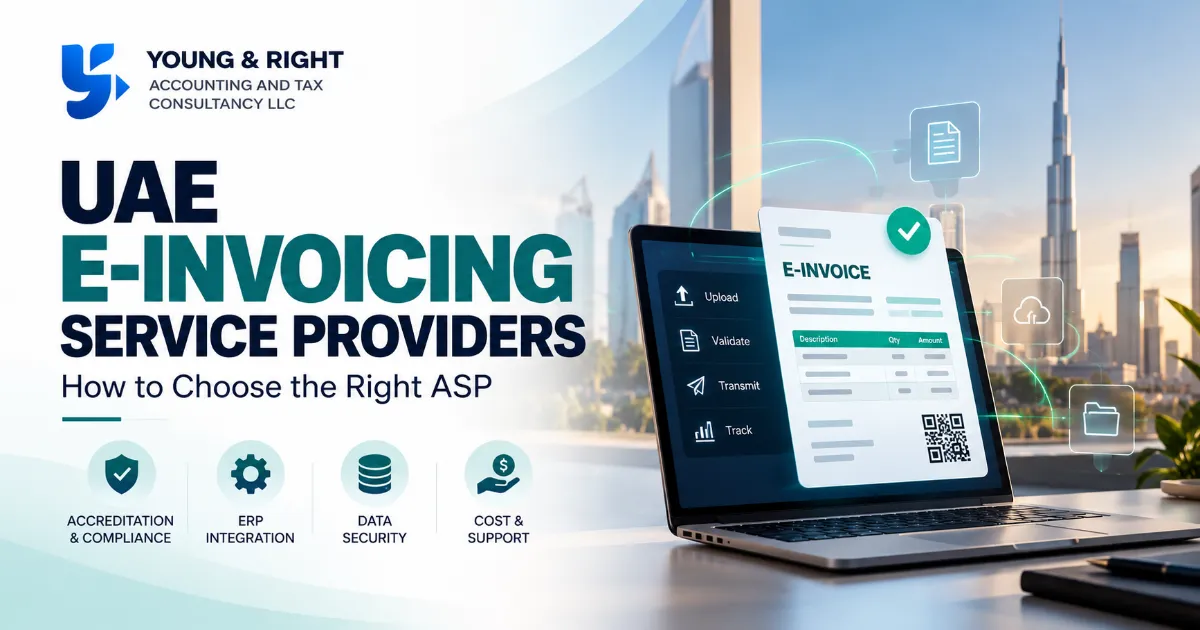
UAE E-Invoicing Service Providers: How to Choose the Right ASP in 2026
09/10/2026
From corporate tax registration to audits and bookkeeping, Young & Right offers personalized solutions that keep your business compliant and stress-free. Let’s take the complexity off your plate—starting with a free consultation.
Book Your Free Consultation

UAE e-invoicing has moved from planning to implementation. The pilot programme and voluntary implementation began on 1 July 2026, while mandatory adoption starts in phases during 2027. For businesses, this is not simply a change from paper invoices to PDF files. It is a shift to structured invoice data exchanged through an accredited network and reported electronically to the Federal Tax Authority (FTA).
The practical message is clear: finance teams should not wait until the final appointment deadline to assess their accounting systems, customer data and invoicing controls. Provider selection, data mapping, testing and staff training can take time, especially where a business uses multiple systems or operates through several legal entities.
Quick answer: A PDF, Word file, scanned invoice, image or ordinary email is not an e-invoice under the UAE framework. A compliant e-invoice is structured, machine-readable invoice data issued and exchanged electronically through the prescribed system.
An e-invoice is invoice data created, transmitted and received in a structured electronic format that allows automatic processing. The UAE model connects the supplier, the supplier's Accredited Service Provider (ASP), the buyer's ASP, the buyer and the FTA. The Ministry of Finance describes this as a decentralised continuous transaction control and exchange model based on the OpenPeppol framework.
This distinction matters. A business may still generate a readable invoice for its staff or customer, but the structured data exchanged through the regulated system is the key compliance document. Simply emailing the same PDF template used today will not satisfy the new definition.
The initial framework generally covers persons carrying on business in the UAE in relation to business-to-business (B2B) and business-to-government (B2G) transactions, subject to specific exclusions. Business-to-consumer (B2C) transactions are not currently included in mandatory implementation until a future ministerial decision brings them into scope.
Businesses should not assume that free-zone status, a small workforce or the absence of VAT registration automatically removes them from scope. The e-invoicing rules use their own definitions and implementation timetable. Each legal entity should therefore assess its revenue, transaction types and any applicable exclusions separately.
UAE e-invoicing timeline
|
Date |
Affected group |
Requirement |
|
1 July 2026 |
Selected taxpayers and voluntary adopters |
Pilot programme and voluntary implementation began. |
|
30 October 2026 |
Businesses with revenue of at least AED 50 million |
Deadline to appoint an Accredited Service Provider. |
|
1 January 2027 |
Businesses with revenue of at least AED 50 million |
Mandatory e-invoicing implementation begins. |
|
31 March 2027 |
Businesses with revenue below AED 50 million |
Deadline to appoint an Accredited Service Provider. |
|
1 July 2027 |
Businesses with revenue below AED 50 million |
Mandatory e-invoicing implementation begins. |
|
31 March 2027 |
In-scope government entities |
Deadline to appoint an Accredited Service Provider. |
|
1 October 2027 |
In-scope government entities |
Mandatory e-invoicing implementation begins. |
For the revenue threshold, Ministerial Decision No. 244 of 2025 refers to gross income earned during the most recent accounting period, based on financial statements or, if those statements are unavailable, other documentation acceptable to the FTA. Ministerial Decision No. 66 of 2026 changed the ASP appointment deadline for the AED 50 million-and-above group from 31 July to 30 October 2026; the 1 January 2027 implementation date remains unchanged.
How the UAE e-invoicing process will work
The supplier creates invoice data in its accounting, billing or enterprise resource planning system.
The supplier sends the data to its UAE Accredited Service Provider, which validates it and converts it to the required UAE structured format when necessary.
The supplier's ASP transmits the structured invoice to the buyer's ASP and reports the required tax data to the FTA.
The buyer's ASP validates the invoice, sends status information and delivers the invoice to the buyer's connected system.
Electronic credit notes must follow the regulated process when a transaction is cancelled, consideration changes, a refund occurs or an error requires correction.
Confirm the applicable phase
Review the most recent accounting period, revenue evidence, transaction types and legal entities. Do not apply one group-wide conclusion without checking each entity.
Map B2B and B2G invoice flows
Identify every system and team that creates invoices, receives supplier invoices, issues credit notes or changes customer master data.
Clean master data
Validate legal names, tax registration numbers, addresses, licence details, customer classifications, item descriptions, units of measure and tax codes.
Assess existing software
Ask whether the current accounting or ERP system can generate the required structured fields, connect to an ASP and receive invoice status messages.
Evaluate accredited providers
Compare official accreditation, integration methods, onboarding support, pricing, data security, service levels, reporting and multi-entity capability.
Design exception handling
Create procedures for rejected invoices, missing buyer data, credit notes, duplicate submissions, system outages and corrections.
Test with real scenarios
Test standard-rated, zero-rated, exempt and out-of-scope transactions, as relevant, together with discounts, deposits, foreign currency and credit notes.
Train finance and commercial teams
Sales, procurement, accounts receivable, accounts payable, tax and IT should understand their responsibilities before go-live.
Common preparation mistakes
Treating e-invoicing as a redesign of the PDF template instead of a structured-data and workflow project.
Waiting to clean customer and supplier records until after an ASP is selected.
Focusing only on outgoing sales invoices and overlooking incoming supplier invoices and credit notes.
Assuming the same onboarding and tax identifiers can be used across multiple legal entities.
Testing only one successful invoice and ignoring rejections, corrections, cancellations and system downtime.
Young and Right can help UAE businesses assess their e-invoicing scope, review invoice and master-data quality, map VAT treatment, prepare readiness checklists and coordinate finance-process improvements. Starting early gives management time to correct data and control weaknesses before they disrupt billing or input processing.


Prepare your systems, data and invoicing processes ahead of the 2027 UAE e-invoicing deadlines and avoid last-minute compliance issues.
Check Your E-Invoicing Readiness